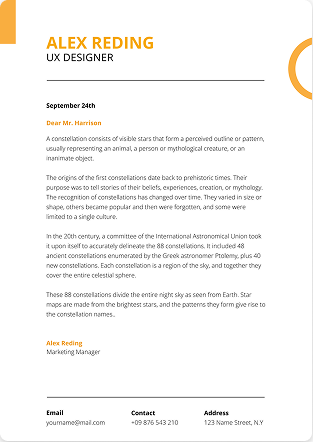

How to make a resume stand out is not fancy design it's relevance made obvious, fast. A standout resume survives the ATS scan, then proves your value to a human in the 6–7 seconds they spend on the first look: tailored keywords, quantified achievements, a sharp summary, and clean formatting. Below guide breaks down the 12 things that get resumes noticed in 2026, what's newly outdated, and how to apply it to your industry.
Key Takeaways
- Your resume has two audiences: the ATS that filters it and the recruiter who skims it in seconds. Win both.
- Relevance beats volume — a tailored, results-focused resume outperforms an impressive but generic one.
- Numbers are what stick. Quantified achievements are the single biggest differentiator.
- In 2026, skills-first layouts, AI/digital skills, and personal branding are in; objectives, buzzwords, photos, and references are out.
What Makes a Resume Stand Out to Recruiters?
Standing out means clearing two gates in under ten seconds.
The first gate is software. Most mid-to-large employers run resumes through an Applicant Tracking System (ATS) that scans for keywords and structure before any human sees them. Poor formatting or missing keywords can end your application here.
The second gate is a busy human. Recruiters spend roughly 6–7 seconds on a first scan, reading in an F-pattern across the top, down the left, pausing on headings. Resumes that survive that scan earn about 30 seconds of real reading.
That's why your top third "above the fold" decides everything. Your name, a compelling summary, and the start of your most relevant experience must sit there. Bury your best material at the bottom and most recruiters never reach it.
Here's the mindset shift that makes a resume stand out: recruiters aren't reading to admire your history they're trying to solve a problem ("can this person do the job, quickly, and stick around?"). Position every line as evidence that you're the answer.
12 Things That Make a Resume Stand Out
1. It's Tailored to the Specific Job
A generic resume that fits every role resonates with none. Mirror the language of each posting: match the job title, pull in repeated keywords, and reorder your bullets so the most relevant experience comes first. You don't need a full rewrite adjust the summary, skills, and top bullets. See how to tailor your resume to a job description for the full method.
2. It's ATS-Friendly
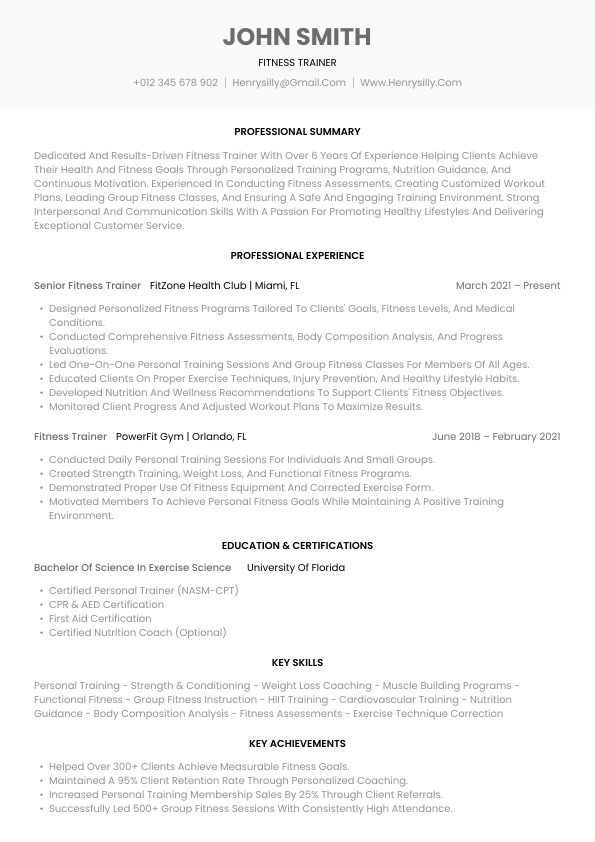
If the software can't read it, the recruiter never will. Keep it parseable: use standard headings (Experience, Skills, Education, Certifications), stick to clean fonts (Arial, Calibri, Times New Roman), use simple bullets, and avoid tables, columns, text boxes, graphics, and icons for anything important. Submit the format the employer asks for — usually a text-based PDF or .docx. Confirm it parses cleanly with the ATS Resume Checker.
3. It Opens With a Strong Summary
Your summary is prime real estate. In three lines, say who you are, what you're great at, and one quantified win:
"Operations manager with 6 years streamlining logistics workflows. Expert in inventory management, vendor negotiation, and team leadership. Cut operating costs 23% while lifting on-time delivery to 98.5%."
Skip vague openers like "hard-working professional seeking growth." Freshers can adapt this see what to write in the About Me section.
4. It Quantifies Achievements
Numbers are the difference between telling and selling. "Improved sales" says nothing; "grew regional sales 47% ($1.2M) in 18 months" proves impact and sticks in memory.
| Weak (duty) | Strong (achievement) |
|---|---|
| Managed a team | Led a 5-person team that increased sales 20% in 6 months |
| Responsible for customer accounts | Managed 45 enterprise accounts ($3.2M ARR) at 112% retention |
| Handled support tickets | Cut average resolution time from 48h to 6h via a new knowledge base |
No hard metrics? Use scale ("trained 25 new hires"), frequency ("processed 200+ invoices weekly"), or ranking ("#2 of 15 reps").
5. It Uses Strong Action Verbs
The first word of each bullet sets the tone. "Responsible for" is passive and forgettable; "Transformed," "Spearheaded," "Accelerated," and "Negotiated" show ownership. Match the verb to your level individual contributors execute and build; leaders direct and champion. More on this in how to use action verbs in a resume.
6. It Leads With Skills (Hard and Soft, Balanced)
Skills-based hiring keeps growing, so a clear, scannable skills section near the top helps you pass ATS and show fit fast. Weight it roughly 70–80% hard skills, 20–30% soft skills, and prove soft skills through your bullets rather than just naming them. Group them (Technical, Tools, Certifications, Languages) for easy scanning. Start from the best skills to put on a resume.
7. Its Bullets Follow a Proven Framework
Standout bullets have structure — action, context, result. Three reliable formulas:
- PAR — Problem → Action → Result. The most versatile; use it when unsure.
- STAR — Situation → Task → Action → Result. Best when context matters (turnarounds, leadership).
- XYZ — Accomplished X, measured by Y, by doing Z. Great for data-driven and tech roles.
Any framework beats a task list. Mix them based on what each achievement needs.
8. It Looks Clean and Readable
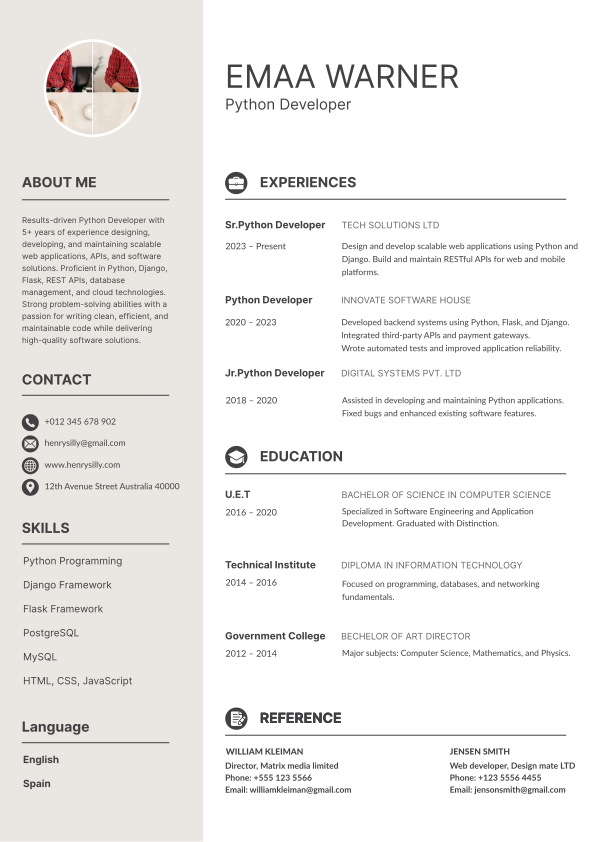
Visual appeal isn't flash it's clarity. Use 0.5–1" margins, generous white space, one or two professional fonts, and a clear size hierarchy (name 16–22pt, headings 12–14pt, body 10–12pt). A single restrained accent color is fine; make sure it still reads in black and white. Cluttered, over-designed templates hurt both ATS parsing and human scanning.
9. It's the Right Length
For most people, one page — two if you're senior and the content is genuinely relevant. Fill at least 80% of the final page; a half-empty second page reads as padding. Full breakdown in how many pages a resume should be.
10. It Showcases Certifications and Projects
For IT, healthcare, finance, construction, and regulated roles, certifications and licenses are often make-or-break list them with issuing body and date, prominently if they're required. A projects section is powerful for career changers, freshers, and portfolio fields: format each like a mini-role with what you built, the tools used, and the measurable result.
11. It Aligns With LinkedIn and a Personal Brand
Recruiters look you up the vast majority vet candidates on LinkedIn. Titles, dates, and companies must match your resume exactly, and your headline should echo your summary. A consistent personal brand across resume, LinkedIn, and portfolio adds credibility. See how to optimize your LinkedIn profile.
12. It's Flawlessly Proofread
A large share of hiring managers discard resumes over typos. One error makes readers doubt everything else. Let it rest overnight, read it aloud, read it backward, and get a second pair of eyes especially on the company name, dates, and your own contact details.
What's In vs What's Out in 2026
The hiring landscape shifted: AI now sits on both sides employers screen with it, and candidates write with it, so the bar for "polished" is higher. Relevance and proof win.
| Out (blends in) | In (stands out) |
|---|---|
| Generic objective statements | Tailored, value-focused summary |
| Buzzwords like "hardworking," "team player" | Measurable results with real numbers |
| One resume sent everywhere | A version tailored to each posting |
| Cluttered, multi-column, graphic-heavy templates | Clean, ATS-friendly, single-column layout |
| Listing duties and responsibilities | Bullets showing impact and outcomes |
| Photos, age, marital status, references | Relevant qualifications; references on request |
| Skills buried at the bottom | Skills-first / hybrid layout up top |
| No mention of digital tools | Relevant AI and digital skills shown with proof |
The 5 P's of a Standout Resume
A quick gut-check before you apply every section should serve at least one:
- Purpose — the value you bring and the role you're targeting are clear.
- Positioning — you emphasize the skills and wins that fit this job.
- Presentation — clean, ATS-friendly layout with readable fonts and headings.
- Proof — every claim is backed by a metric, example, or certification.
- Personalization — the resume is tailored to the specific posting.
What Makes a Resume Stand Out by Industry?
The last 20% what separates good from great comes from speaking your industry's language. Here's what to emphasize across resume industries:
| Industry | What makes it stand out |
|---|---|
| Software Development / IT | A categorized tech-skills block, GitHub/portfolio links, metrics like latency or scale |
| Advertising, Marketing & PR | Campaign results (leads, ROI, conversion) plus a portfolio link |
| Sales | Every role led with quota attainment, revenue, and rankings |
| Financial Services / Accounting | Credentials up top (CPA/CFA), deal sizes, precision, dollar impact |
| Healthcare / Medical | Active licenses with dates, EHR systems, patient outcomes, HIPAA/OSHA |
| Engineering / Construction | Certifications, safety records, project scope and schedule performance |
| Education | Certifications, subject expertise, quantified student outcomes |
| Human Resources | Programs run, retention/time-to-hire metrics, systems used |
Common Mistakes That Make a Resume Blend In
- No numbers — the fastest way to look like everyone else.
- Same resume everywhere — recruiters and ATS both notice.
- Duty lists instead of achievements — describe impact, not your job description.
- A weak first page — your strongest proof must be above the fold.
- Over-design — graphics and columns break ATS parsing and bury content.
- Typos — one error undoes an otherwise strong resume.
Frequently Asked Questions
Q1. What makes a resume stand out to employers?
Relevance made obvious, fast: keywords matched to the job, quantified achievements, a sharp summary, and clean ATS-friendly formatting with your best proof in the top third.
Q2. How do I make my resume stand out with no experience?
Use transferable skills, coursework, projects, internships, and volunteer work, and quantify them with the same frameworks (PAR, STAR). Tailor heavily to each role. See how to write a resume with no experience.
Q3. How many seconds do recruiters spend on a resume?
About 6–7 seconds on the first scan. Resumes that pass earn roughly 30 seconds of real reading so lead with your strongest, most relevant material.
Q4. What color makes a resume stand out?
A single subtle accent (navy, teal, burgundy) for headings or lines. Keep it readable in grayscale; conservative fields expect black and white.
Q5. Does AI make resumes stand out or blend in?
Both. AI helps you tailor and polish, but when everyone uses it, generic phrasing spreads. Stand out by adding specifics only you would know real numbers, project names, and outcomes.
Q6. What is the number one thing employers look for?
Relevance a clear match between what they need and what you've done. Tailoring makes that match obvious in seconds.
Final Lines
What makes a resume stand out in 2026 isn't a template trick it's clarity and proof, built for both the algorithm and the human. Tailor it, quantify it, lead with skills, keep it clean, and make your strongest evidence impossible to miss in the first few seconds.
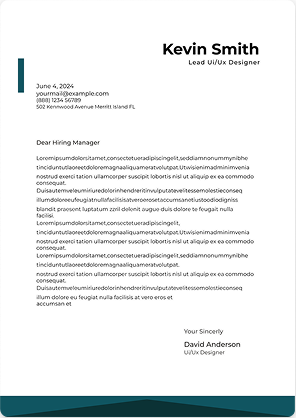
Want it done for you? Build your resume with AI to get an ATS-friendly, results-focused draft in minutes then pair it with a matching cover letter so your whole application tells one story.