
The best good skills to put on a resume are the ones that match the job description, pass the ATS scan, and prove you can do the work a tight mix of hard skills (measurable, teachable abilities) and soft skills (how you work with people and problems). Below guide breaks down why skills matter, how ATS reads them, the ideal balance, and the top hard and soft skills for multiple job industries.
Why Are Skills Important on a Resume?
Skills are the fastest signal a recruiter or algorithm uses to decide if you're a match. In the first 6–7 seconds a hiring manager spends scanning your resume, your skills section tells them whether to keep reading.
Here's why the skills section carries so much weight:
- It's the first keyword match. Recruiters and software search resumes by skill keywords pulled straight from the job posting.
- It proves capability, not just history. Job titles show where you worked; skills show what you can actually do.
- It ranks you against other applicants. Two candidates with the same title stand out based on the depth and relevance of their listed skills.
- It shortcuts the "fit" question. A well-chosen skill set signals you understand the role before the interview even starts.
Bottom line: listing the right skills is the difference between a resume that gets read and one that gets filtered out.
Does Listing Skills Properly Help With ATS?
Yes. An Applicant Tracking System (ATS) parses your resume, extracts your skills, and matches them against the job description. Formatting your skills correctly directly improves your match score and your odds of reaching a human.
How ATS reads your skills:
- It scans for exact-match and close-match keywords from the job posting.
- It reads a clearly labeled "Skills" section far more reliably than skills buried in paragraphs.
- It struggles with skills hidden inside tables, columns, headers, images, or graphics — these often get skipped entirely.
To make your skills ATS-friendly:
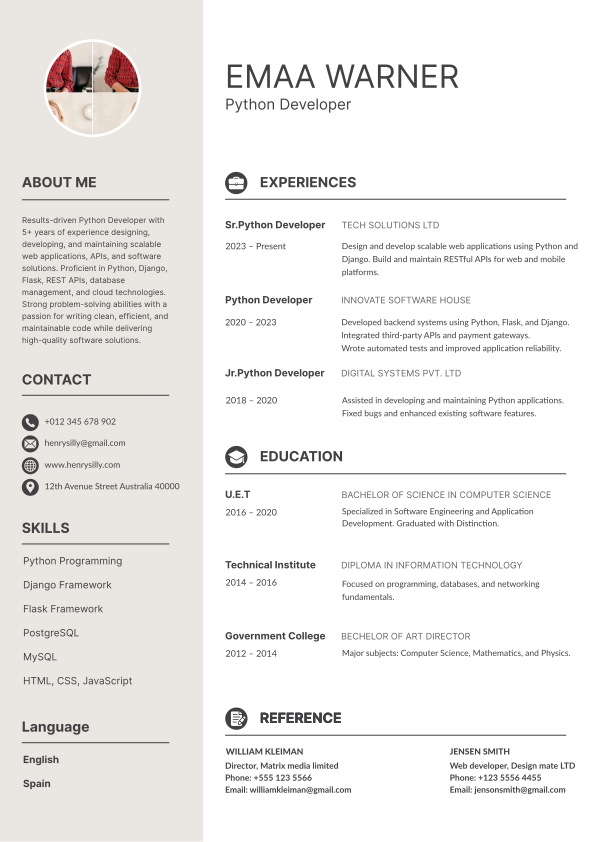
- Use a standard heading like "Skills" or "Core Competencies."
- Mirror the exact wording of the job description (e.g., if they write "SEO," don't only write "search engine optimization" use both).
- List skills as plain text, not inside graphics or text boxes.
- Add skills in two places: a dedicated skills section and woven naturally into your work experience bullets.
- Skip skill "rating bars" — ATS can't read them, and recruiters distrust them.
Quick tip: Run your resume through an ATS Resume Checker before you apply to see which skills are being detected.
What Are Hard Skills?
Hard skills are specific, teachable, measurable abilities you learn through training, education, or hands-on practice. They're job-specific and easy to prove.
Examples of hard skills:
- Programming languages (Python, JavaScript, SQL)
- Data analysis and Excel modeling
- SEO, PPC, and Google Analytics
- Accounting and financial reporting
- Graphic design (Figma, Adobe Creative Suite)
- Foreign languages
- Machine operation, welding, or CAD
- Project management tools (Jira, Asana)
If you can earn a certificate in it or test it, it's usually a hard skill.
What Are Soft Skills?
Soft skills are the personal and interpersonal traits that shape how you work — with people, under pressure, and through change. They're harder to measure but often decide who gets promoted.
Examples of soft skills:
- Communication
- Leadership
- Problem-solving
- Adaptability
- Time management
- Teamwork and collaboration
- Emotional intelligence
- Critical thinking
Soft skills transfer across every job and industry, which is why they matter even in highly technical roles.
Hard Skills vs Soft Skills: What's the Right Weightage on a Resume?
There's no fixed rule, but a strong resume leans on hard skills for relevance and soft skills for differentiation. A practical guideline:
| Role type | Suggested skill balance | Why |
|---|---|---|
| Technical (developer, engineer, analyst) | ~70% hard / 30% soft | Employers screen first for provable technical ability. |
| Client-facing (sales, marketing, HR, hospitality) | ~50% hard / 50% soft | Relationships and communication drive results. |
| Leadership & management | ~40% hard / 60% soft | Strategy, people management, and decision-making dominate. |
| Entry-level | ~40% hard / 60% soft | Less experience means transferable soft skills carry more weight. |
Rules of thumb:
- List 6–12 skills in your skills section — enough to show range, not so many it looks padded.
- Lead with hard skills that match the job title, then reinforce with soft skills.
- Prove soft skills in your experience bullets ("led a team of 6") rather than just naming them.
- Always tailor per application — the right weightage shifts with every job description.
Best Hard & Soft Skills by Industry
Different industries reward different skill sets. Below are the top hard and soft skills for 40+ resume industries use them to tailor your skills section to your exact field.
| Industry | Top Hard Skills | Top Soft Skills |
|---|---|---|
| Software Development | Python, JavaScript, Git, testing/QA, APIs | Problem-solving, collaboration, attention to detail |
| Information Technology | Networking, cloud (AWS), system administration, cybersecurity | Troubleshooting, communication, adaptability |
| Engineering | CAD, technical design, math modeling, quality control | Analytical thinking, teamwork, precision |
| Sales | CRM (Salesforce), lead generation, forecasting, negotiation | Persuasion, relationship-building, resilience |
| Advertising, Marketing & PR | SEO, PPC, Google Analytics, content strategy, social media | Creativity, communication, storytelling |
| Healthcare & Pharmacy | Patient care, medical records (EHR), clinical procedures, pharmacology | Empathy, attention to detail, composure |
| Medical | Diagnostics, lab work, HIPAA compliance, patient assessment | Bedside manner, teamwork, decision-making |
| Therapy | Treatment planning, clinical assessment, documentation | Active listening, empathy, patience |
| Financial Services | Financial modeling, forecasting, risk analysis, Excel | Analytical thinking, integrity, communication |
| Banking | Loan processing, compliance, financial products, data entry | Trustworthiness, customer service, accuracy |
| Accounting & Auditing | GAAP, reconciliation, tax prep, QuickBooks, auditing | Attention to detail, integrity, organization |
| Insurance | Claims processing, underwriting, risk assessment, policy analysis | Analytical thinking, negotiation, communication |
| Business Management | Budgeting, KPIs, operations, project management | Leadership, decision-making, delegation |
| Business Strategy & Analysis | Data analysis, SQL, forecasting, market research | Critical thinking, communication, curiosity |
| Consulting | Analysis frameworks, PowerPoint, research, process mapping | Problem-solving, client management, adaptability |
| Human Resources | Recruiting, HRIS, onboarding, labor law, payroll | Empathy, conflict resolution, discretion |
| Legal | Legal research, drafting, case management, compliance | Critical thinking, attention to detail, ethics |
| Education | Curriculum design, lesson planning, assessment, LMS tools | Patience, communication, adaptability |
| Research | Data analysis, statistics, methodology, technical writing | Curiosity, critical thinking, persistence |
| Science & Biotech | Lab techniques, data analysis, protocols, regulatory standards | Precision, analytical thinking, collaboration |
| Real Estate | Market analysis, CRM, contracts, property valuation | Negotiation, relationship-building, persuasion |
| Retail | POS systems, inventory, merchandising, sales targets | Customer service, communication, patience |
| Hospitality | POS, food safety, reservations, event coordination | Customer service, teamwork, composure under pressure |
| Manufacturing | Machine operation, quality control, lean/Six Sigma, safety | Attention to detail, reliability, teamwork |
| Logistics & Supply Chain | Inventory management, ERP, route planning, forecasting | Organization, problem-solving, time management |
| Transportation | Route planning, vehicle operation, safety compliance, logistics | Reliability, focus, time management |
| Building & Construction | Blueprint reading, AutoCAD, project scheduling, safety codes | Teamwork, problem-solving, physical stamina |
| Maintenance & Repair | Troubleshooting, electrical/mechanical repair, preventive maintenance | Reliability, problem-solving, attention to detail |
| Art, Creative & Design | Adobe Creative Suite, Figma, typography, UX/UI | Creativity, communication, adaptability |
| Fashion & Beauty | Styling, product knowledge, trend analysis, client consultation | Creativity, communication, customer service |
| Media & Journalism | Writing, editing, CMS, research, SEO | Storytelling, communication, deadline management |
| Government | Policy analysis, compliance, budgeting, public administration | Communication, integrity, organization |
| Law Enforcement, Military & Security | Surveillance, report writing, safety protocols, investigation | Discipline, decision-making, situational awareness |
| Administrative & Clerical | Scheduling, MS Office, data entry, bookkeeping | Organization, communication, multitasking |
| Child Care | First aid/CPR, activity planning, child development, safety | Patience, empathy, communication |
| Animal Care | Animal handling, grooming, basic veterinary care, feeding protocols | Compassion, patience, attention to detail |
| Fitness | Program design, anatomy, coaching techniques, CPR | Motivation, communication, empathy |
| Charity & Non-Profit | Fundraising, grant writing, event planning, outreach | Empathy, communication, organization |
Tip: Pick 6–10 skills from your industry row, then swap in the exact keywords from the specific job posting you're applying to.
How to List Skills on Your Resume (Format Tips)
Even the right skills fail if they're formatted poorly. Follow these rules:
Create a dedicated skills section near the top (or beside your experience) with a clean "Skills" heading.Group by type if the list is long — e.g., "Technical Skills" and "Soft Skills."
Match the job description language word-for-word where it's honest to do so.
Quantify in your experience section — instead of just "leadership," write "led a 6-person team to a 20% revenue increase."
Keep it current and relevant — drop outdated tools and skills unrelated to the target role.
Stay honest — only list skills you can defend in an interview.
Want it done automatically? The AI Resume Builder suggests role-specific skills as you build.
Frequently Asked Questions
Q1. What are the best skills to put on a resume in 2026?
The best skills combine in-demand hard skills (data analysis, digital/AI tools, project management) with universal soft skills (communication, adaptability, problem-solving) always tailored to the specific job description.
Q2. How many skills should I list on a resume?
List 6–12 skills in your dedicated skills section. Enough to show range, few enough that every one is relevant and defensible.
Q3. Should I include soft skills on my resume?
Yes. Soft skills like communication and leadership differentiate you from equally qualified candidates, especially for client-facing and leadership roles. Prove them with examples in your experience section.
Q4. Do skills on a resume help pass the ATS?
Yes. A clearly labeled skills section with keywords matching the job description significantly improves your ATS match score and your chances of reaching a recruiter.
Q5. What's the difference between hard skills and soft skills?
Hard skills are teachable, measurable abilities (coding, accounting, SEO). Soft skills are personal traits that shape how you work (communication, teamwork, adaptability).
Q6. Where should the skills section go on a resume?
Near the top for skills-based or entry-level resumes, or alongside your experience for mid-to-senior roles. Keep it easy for both recruiters and ATS to find.
Key Takeaways
- The best good skills to put on a resume are relevant, keyword-matched, and split between hard and soft skills.
- A clear, plain-text skills section improves your ATS score and readability.
- Hard skills prove capability; soft skills set you apart — balance them to your role.
- Tailor your skills to every job using the industry table above and the exact job posting.
Ready to build a skills section that gets noticed? Create your resume with AI and let AI Resume Lab match the right skills to your target role.