
An action verb is formally defined as “a verb that expresses action”. In other words, it describes something that a person, animal, object or idea does, rather than merely a state of being. For example, drive in “We drive past their house” and “Let’s think about the problem” are action verbs. A language tutorial further explains that in a sentence the pattern is Subject → Action Verb → Object, illustrating doing.
For instance, in “Greg is kicking the ball,”kicking is an action verb describing Greg’s motion. Likewise, in “He accepted my apology,” accepted is the action verb showing what he did. By contrast, linking verbs (like is, become, seem) do not describe actions but simply connect the subject to a description.
Why Use Action Verbs on a Resume?
Action verbs bring writing to life and are especially powerful on resumes. Career experts note that each bullet or statement on your resume should begin with an action verb to focus attention on what you achieved. For example, MIT’s career center advises: “Begin each bullet point statement… with an action verb that points the reader to the skill you are trying to highlight”.
In practice, using strong action verbs highlights your accomplishments and skills, making your resume more vivid and engaging. The Muse emphasizes that action verbs “show readers you accomplished something at your past jobs” and moves beyond weak phrases like “responsible for” to more powerful terms like streamlined, coordinated or executed.
Highlight achievements.
Action verbs quickly communicate what you did. Indeed notes that unique, specific verbs “clarify your contributions and bring a confident tone” to your resume. For instance, saying “Achieved a 20% sales increase” packs more punch than “Was responsible for sales increase.”
Improve clarity.
Active (action) verbs make the subject of each statement do the work, so sentences are clear and concise. In contrast, passive phrasing (“was given charge of…”) tends to be “clunky and harder to interpret”.
Impress ATS and recruiters.
Most applicant-tracking systems and hiring managers favor bullet points in active voice. Indeed explains that ATS often scan for keywords (many of which are action verbs) and can better parse active statements. Also, action verbs demonstrate ownership: saying “I managed the project” shows you took control, whereas “I was tasked with managing” sounds weaker.
How to Use Action Verbs on Your Resume?
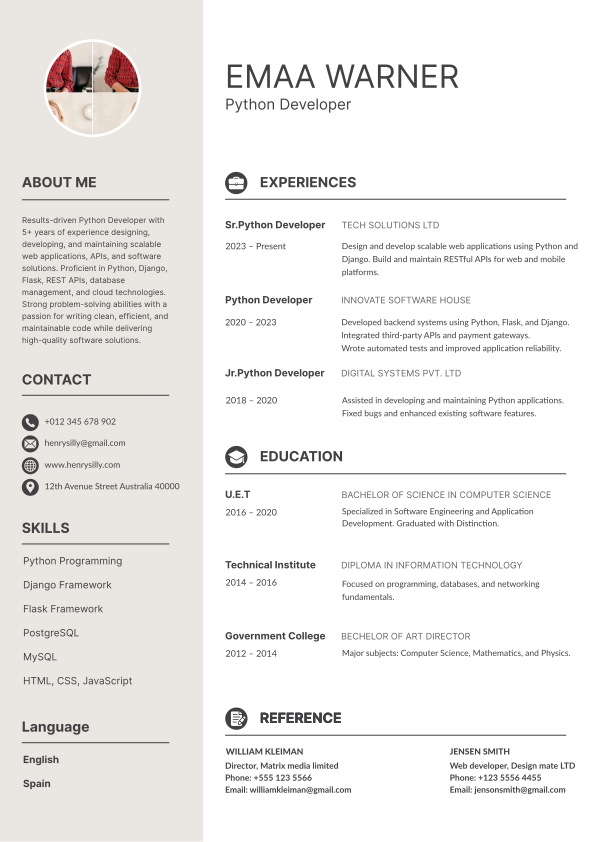
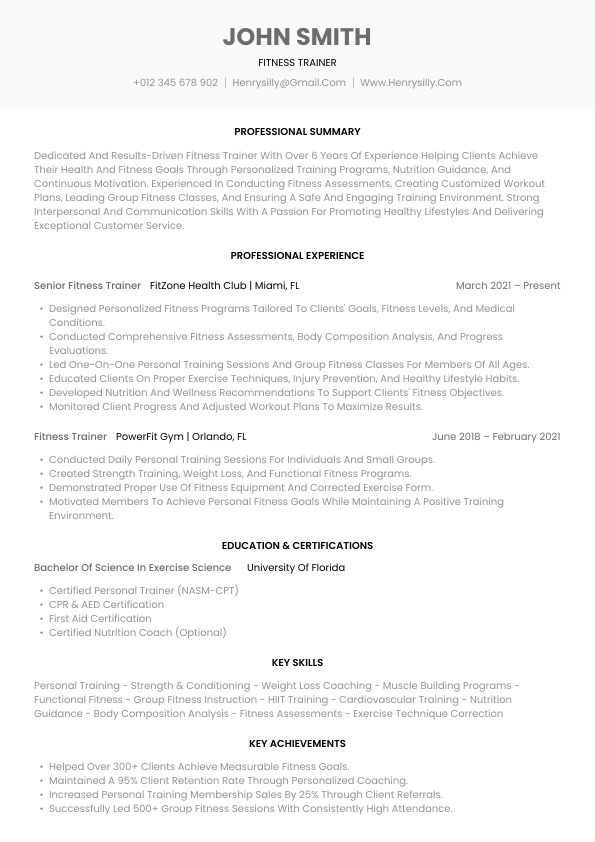
Start each bullet with a strong verb. As noted, make each resume line begin with an action verb (e.g. managed, designed, implemented). This immediately signals your role in the accomplishment.
Match verb tense to the job. Use present-tense verbs for your current position and past-tense for previous jobs. For example, “Manage a team of five” (present role) vs. “Managed a team of five” (former role). Avoid mixing tenses under one employer heading.
Be specific and quantify. Whenever possible, pair action verbs with concrete results (e.g. “Increased revenue by 30%” rather than just “Increased sales”). This combines a verb with measurable achievement.
Use varied verbs. Don’t repeat the same verb in every bullet. Mix in synonyms to keep the reader engaged (e.g. led, directed, orchestrated instead of using “led” repeatedly). Also avoid vague or overused verbs – The Muse warns that terms like “led” or “handled” can be too general unless you add detail.
Examples of Action Verbs by Context
Action verbs can be chosen to fit the situation. For example, verbs for accomplishments (e.g. achieved, exceeded, spearheaded) emphasize results, while verbs for responsibilities (e.g. coordinated, developed, organized) describe duties. Communication verbs (e.g. advised, collaborated, presented) suit teamwork, and leadership verbs (e.g. mentored, facilitated, motivated) suit management roles. Indeed’s career guide provides categorized verb lists (such as “Action verbs for accomplishments” and “for responsibilities”) to spark ideas. Below are a few illustrative examples:
Achieved: Accomplishment (e.g. achieved, exceeded, spearheaded).
Coordinated: Responsibility/Project (e.g. coordinated, implemented, organized).
Presented: Communication (e.g. presented, negotiated, collaborated).
Designed: Creative/Technical (e.g. designed, engineered, developed).
Use only those verbs that truly match your experience. Resources like MIT and Indeed offer long lists of resume action verbs, but tailor them to your work (e.g. tech jobs might favor engineered, finance might use budgeted, etc.).
Verb Tense and Voice on a Resume
Keep your resume in the active voice and consistent tense. As one guide instructs: “If you’re writing about current… responsibilities, use the present tense (e.g. write, plan). If about past jobs, use past tense (e.g. wrote, planned).”. In other words, say “Developed marketing strategy” (past role) and “Manage social media accounts” (current role). Avoid passive constructions like “was responsible for” altogether. Using action verbs inherently creates active-voice statements, which are more compelling.
Common Pitfalls to Avoid
Don’t use weak phrases. Phrases like “responsible for,” “involved in,” or “tasks included” sound passive. Replace them with a verb, e.g., “Coordinated monthly reports” instead of “Responsible for coordinating reports.”
Don’t overuse certain words. Even good verbs can grow stale if repeated. For example, The Muse cautions that words like “led” or “handled” can become too generic without context. Instead, alternate with synonyms or more vivid verbs.
Stay truthful. Use action verbs genuinely—don’t oversell beyond your actual role. Always be ready to back up any achievement you list. (Quantifying results helps maintain accuracy.)
Frequently Asked Questions
Q1. What exactly is an action verb?
It’s a verb that shows action (doing something), not merely being. Action verbs put the subject in motion. For example, in “The team executed the plan,” executed is an action verb meaning they carried out the plan.
Q2. Why are action verbs important on a resume?
Because they highlight your accomplishments and make your experience stand out. Starting bullet points with strong verbs (e.g. managed, improved, launched) paints a clear picture of your initiative. Recruiters and ATS alike favor active phrasing.
Q3. When should I use past vs. present tense for action verbs?
Use present tense for duties you still perform, and past tense for previous jobs. For example: “Manage five staff members” (current) but “Managed five staff members” (former). Indeed’s resume guide advises: “If you’re writing about current… responsibilities… use present; if past, use past”. Keep each job section consistent and don’t mix tenses under the same role.
Q4. Should every bullet on my resume start with an action verb?
Generally, yes. Beginning each bullet with an action verb (rather than “I” or a passive phrase) ensures your statements are strong and direct. However this approach immediately shows what you did. (The only exception might be very brief statements that follow a heading, but even then active phrasing is preferred.)
Q5. Can you give examples of strong action verbs?
Certainly. Examples include “achieved,” “spearheaded,” “optimized,” “implemented,” “analyzed,” and “transformed.” Different contexts use different verbs: “achieved/exceeded” for accomplishments, “led/managed” for leadership, “created/designed” for creative work, “engineered/resolved” for technical tasks, etc. Many job guides list hundreds of verbs; for instance, Indeed’s list includes “administrated,” “exceeded,” “collaborated,” “founded,” and more. Use ones that precisely fit what you did.
Q6. How do I avoid overusing or misusing action verbs?
Vary your word choice and back each verb with detail or result. Don’t just say “led team” — specify how or to what end (e.g. “Led a team of 4 to develop a new product, achieving a 15% sales increase”). Also avoid frequently repeating the same verbs (rotate synonyms) and steer clear of hollow words like “handled” without context.
Final Thoughts
Action verbs are the building blocks of a dynamic, results-focused resume. They instantly convey what you did, making your bullets more powerful and concise. By carefully selecting and correctly using action verbs (with proper tense and active voice), you make your accomplishments shine.
As one guide advises, aim to “paint a picture” with your verbs. Ultimately, the right verb can turn a bland task statement into a strong achievement highlight – helping you stand out to employers and move forward in the hiring process.