Embedded Software Engineer Resume: Sample, Skills & Job-Search Guide
Most guides tell you to "quantify your achievements" and leave you staring at a blank page. This one gives you the finished artifact first a complete embedded software engineer resume you can read top to bottom then breaks down why each line works and how to swap in your own platforms and numbers.
Because embedded hiring is unusually literal. Screeners look for the exact MCU family, the exact RTOS, the exact bus, and a number attached to each. "Experience with microcontrollers" gets filtered. "FreeRTOS on STM32F4, cut boot time 42% across 40K units" gets read.
The Complete Sample Resume
Copy the structure, replace the specifics. This is a mid-level profile intern and senior variations follow further down.
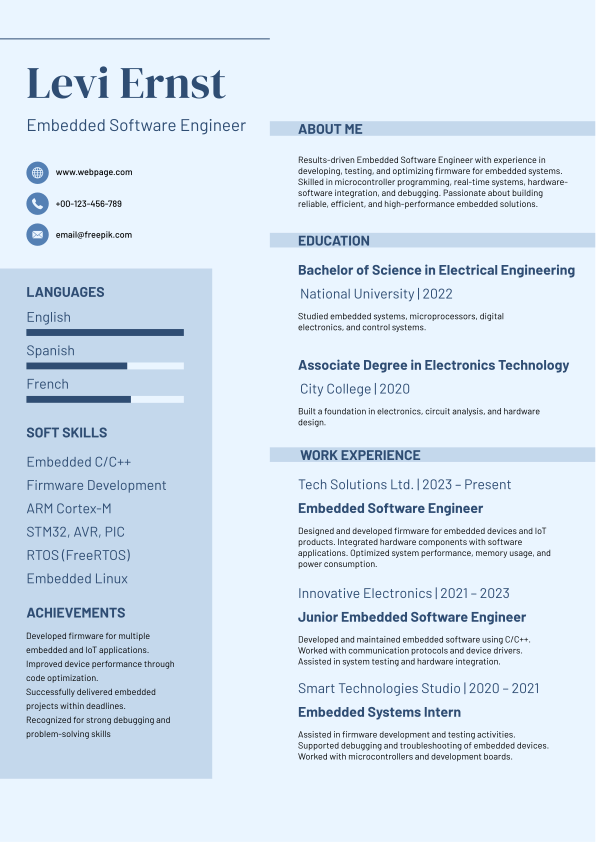
Ayesha Khan
Embedded Software Engineer | C/C++ | FreeRTOS | ARM Cortex-M | I2C, SPI, CAN
Islamabad, PK • [email protected] • +92-3XX-XXXXXXX • github.com/ayeshak-dev • linkedin.com/in/ayeshakhan
Summary Embedded Software Engineer with 5 years developing bare-metal and RTOS firmware on ARM Cortex-M for industrial IoT devices. Shipped firmware running on 40K+ deployed units, reduced boot time 42% and average current draw 31%, and led board bring-up across 6 custom PCB revisions.
Skills Languages: C, C++, Python (test tooling), ARM assembly
RTOS/OS: FreeRTOS, Zephyr, embedded Linux (Yocto basics)
Platforms: STM32F4/L4, nRF52, ESP32, ARM Cortex-M0/M4/M7
Protocols: I2C, SPI, UART, CAN, BLE, MQTT
Debug/Test: JTAG/SWD, J-Link, GDB, oscilloscopes, logic analyzers, Unity, HIL benches
Practices: MISRA C, static analysis, secure boot, OTA updates, Git, CI/CD
Experience
Embedded Software Engineer — NovaSense Systems, Islamabad | 2022–Present
- Architected FreeRTOS firmware on STM32F4 for a wireless sensor gateway, cutting sensor-to-cloud latency from 180 ms to 110 ms across 12K fielded units
- Rewrote SPI/I2C driver stack with DMA and interrupt coalescing, lowering CPU utilization 26% and extending battery life 19%
- Shrank firmware image from 612 KB to 498 KB via link-time optimization and dead-code removal, freeing headroom for OTA
- Led board bring-up for 6 PCB revisions; root-caused intermittent brownout resets with logic analyzer traces, cutting RMA rate 22%
- Built hardware-in-the-loop regression benches in GitHub Actions, raising test coverage 45% → 81%
Firmware Engineer — MicroEdge Devices, Lahore | 2020–2022
- Developed bare-metal C drivers for sensor peripherals on nRF52, achieving deterministic 10 ms sampling with zero deadline misses over 72-hour stress tests
- Implemented secure boot and signed OTA updates with mbed TLS, passing third-party penetration testing with zero critical findings
- Reduced average current from 18 mA to 11 mA via tickless idle, peripheral gating, and BLE advertising tuning
Projects Open-source FreeRTOS sensor-logging library — 300+ GitHub stars; used in 3 published hobbyist builds
Education BS Electrical Engineering — [University], 2020
Certifications ARM Accredited Engineer (2023) • Functional Safety Fundamentals, ISO 26262 (2024)
Why That Resume Works: The Four Rules
Rule 1 — Name the Part, Not the Category
Every embedded systems resume that gets shortlisted names specific silicon. "STM32F407 running FreeRTOS 10.4, debugged with J-Link" is verifiable. "Microcontrollers and RTOS" is a syllabus line. Screeners in this field are engineers; vagueness reads as inexperience, not modesty.
Rule 2 — Use the Metrics Only Embedded Has
Web developers have page loads. You have microseconds, milliamps, and kilobytes:
| Metric type | Example bullet fragment |
|---|---|
| Latency | "cut interrupt handling from 120 µs to 45 µs" |
| Power | "reduced average current 18 mA → 11 mA" |
| Memory | "shrank image 612 KB → 498 KB" |
| Reliability | "field crash rate 2.1% → 0.4% across 12K units" |
| Delivery | "release cycle 4 weeks → 2 via CI and HIL smoke tests" |
Rule 3 — Show Scale in Deployed Units
"Worked on 3 projects" says nothing about impact. "Firmware running on 40K+ shipped devices" tells a hiring manager your code survived contact with the real world with the single strongest embedded credential.
Rule 4 — Mirror the Posting's Exact Vocabulary
ATS matching here is literal. If the ad says "AUTOSAR Classic," write AUTOSAR Classic. If it says "board bring-up," don't write "hardware initialization." Tailoring is 10 minutes of find-and-replace against your master version.
Level-by-Level: What Changes as You Grow
Embedded Systems Intern Resume
An embedded systems intern resume runs on projects, not tenure. Use hybrid format skills and projects above education and document real hardware work with test evidence.
Summary: Computer Engineering student with hands-on bare-metal C experience on STM32 and ESP32. Built a multi-sensor data logger with FreeRTOS priority scheduling achieving deterministic 10 ms sampling with zero deadline misses over 72-hour stress tests. Comfortable with SPI, I2C, UART, J-Link, and logic analyzers.
What counts as experience at this stage: Capstone and senior design, robotics club firmware, populated-and-debugged student PCBs, open-source driver patches, and any internship or lab assistantship. List them under Experience not buried under Education.
Mid-Level (2–6 Years)
The shift from intern to mid-level is ownership language. "Assisted with driver development" becomes "owned the sensor driver stack across 3 product variants." Add board bring-up responsibility, cross-functional work with hardware engineers, and at least one shipped product with unit counts.
Senior Embedded Software Engineer Resume
A senior embedded software engineer resume that only lists hands-on work reads as mid-level. Seniority shows through architecture, standards, and people:
Summary: Senior Embedded Software Engineer with 10 years architecting firmware for safety-critical medical and industrial devices. Led platform migration across 3 product lines enabling 70% code reuse, established the firmware CI and MISRA gating now used by 14 engineers, and reduced field defect escapes 60% over two years.
Senior-only bullet types: Platform architecture decisions, silicon vendor evaluation, BOM cost-vs-performance trade-offs, standards ownership (MISRA/static analysis gating), mentorship with outcomes ("2 engineers promoted"), and business impact in currency ("$180K annual warranty savings").
Domain Variations: Same Resume, Different Vocabulary
Your core structure stays fixed; the keyword layer swaps entirely by target.
Embedded Firmware Engineer Resume
An embedded firmware engineer's resume leans closest to silicon: register-level peripheral configuration, bare-metal drivers, bootloaders, memory maps, and power states. Emphasize footprint and timing numbers above all else, and name your toolchain (GCC ARM, IAR, Keil).
Automotive Embedded Software Engineer Resume
An automotive embedded software engineer resume screens on compliance vocabulary as hard as on C:
- AUTOSAR Classic/Adaptive (BSW configuration, RTE integration)
- CAN / CAN-FD / LIN / FlexRay, UDS diagnostics
- ISO 26262 (state your ASIL level), MISRA C, Polyspace/PC-lint
- CANoe/CANalyzer, dSPACE HIL benches, OEM audit experience
Sample bullet: "Enforced MISRA C compliance via static analysis and authored 200+ Unity unit tests for an ASIL-B body control module, achieving zero critical defects across two release cycles."
Embedded Linux Resume
An embedded linux resume sits a layer up — kernel space and build systems rather than bare metal:
- Yocto/OpenEmbedded layer maintenance, Buildroot
- Device tree bindings, character and platform drivers, kernel modules
- U-Boot, systemd, initramfs, cross-compilation toolchains
- ftrace, perf, kgdb for kernel debugging
Sample bullet: "Reduced boot time 14 s → 6 s via U-Boot trimming, initramfs optimization, and parallel systemd unit ordering across 4 product families."
Targeting Big Tech: The Google Embedded Engineer Resume Question
Writing a google embedded engineer resume or one aimed at Apple, Tesla, Qualcomm, or Blue Origin changes emphasis, not fundamentals:
- Algorithms reappear — big-tech embedded loops often include DS&A screens; algorithm signals help here more than at hardware-first shops
- Scale language wins — "firmware on 2M+ shipped devices" outperforms any project count
- Systems breadth expected — Linux, Python tooling, and CI fluency alongside bare-metal depth
- One page, strictly — even at senior level
- Referrals outperform applications — the resume gets parsed; a referral gets it read
Everything else named platforms, quantified bullets, literal keyword mirroring is identical to any strong embedded resume.
What Reddit Gets Right About Embedded Resumes?
Search embedded software engineer resume reddit and r/embedded's crowd-sourced consensus lines up closely with hiring-manager advice:
- Documented projects beat GPA — with photos, schematics, and scope
- Name your parts — the single most repeated critique of junior resumes
- Bare-metal credibility matters — Arduino-only portfolios get flagged; register-level work signals depth
- One page, unanimously
Worth ignoring:
The pessimism about breaking in without a hardware degree (CS grads with real builds do get hired), and title snobbery between "firmware" and "embedded software" the roles overlap heavily, so apply to both.
Where to Find Embedded Software Engineer Jobs
Your resume performs differently by channel, so it's worth knowing where embedded software engineer jobs actually concentrate:
- Defense and aerospace — Blue Origin, General Dynamics, Northrop Grumman, RTX; expect on-site work and clearance requirements in the US
- Automotive and EV — Tesla, OEMs, and Tier-1 suppliers; AUTOSAR and ISO 26262 keywords dominate
- Consumer silicon — Apple, Qualcomm; heaviest algorithm screening
- Industrial IoT and medical devices — steadier hiring, deep RTOS and reliability focus
- Staffing firms — high volume, keyword-driven parsing; keep a .docx version ready for them
Practical note:
Embedded roles skew heavily on-site compared with the rest of software. Filtering exclusively for remote will shrink your funnel dramatically — worth knowing before you conclude the market is closed.
An embedded software engineer designs, writes, and validates firmware that runs directly on hardware, usually under real-time, memory, and power constraints — which is why every screening signal above ties back to constrained-resource evidence rather than general coding ability.
Common Mistakes
- Category language instead of part numbers — the number one filter-out
- No hardware metrics — omitting µs/mA/KB wastes your strongest differentiator
- Domain-blind resumes — automotive and Linux BSP postings share almost no keywords
- Projects buried below education — for juniors, projects are the experience section
- Two pages before senior level — one page is the norm across this field
Embedded Software Engineer Resume FAQs
Q1. What should an embedded software engineer resume include?
Named platforms (MCU family, RTOS, toolchain), protocols, and debug tools, each attached to a quantified result latency, current draw, memory footprint, field-failure rate, or deployed-unit count.
Q2. How do I write one with no professional experience?
Hybrid format: skills and hardware projects above education, with parts named, test evidence included, and measurable results. Capstone, robotics, and open-source contributions all belong under Experience.
Q3. Is a firmware engineer the same as an embedded software engineer?
They overlap heavily. Firmware usually implies bare-metal, closer-to-silicon work; embedded software can extend into Linux and application layers. Mirror whichever title the posting uses, and apply to both.
Q4. How long should the resume be?
One page through mid-level and for big-tech applications; two pages maximum for senior profiles with long platform histories.
Q5. Do certifications matter?
Modestly. ARM Accredited Engineer, Yocto training, and functional-safety (ISO 26262) credentials help in specific domains, but shipped firmware with numbers outranks any certificate.
Final Words
An embedded software engineer's resume should behave like the firmware it describes: deterministic every claim verifiable; resource-constrained one page, no filler; and validated a number wherever others put an adjective.
Take the sample at the top, swap in your silicon, your protocols, and your measurements, then tailor the vocabulary to each posting's exact terms. The engineers who get interviews aren't always the strongest ones they're the ones whose resumes made the evidence impossible to miss.
Your resume runs on a 7-second interrupt. Return something useful before the timer expires.