Embedded Engineer Resume: Firmware, Automotive & Linux Examples
Embedded engineering resumes fail for a reason no other software resume shares: they read like task logs from a lab notebook. "Wrote firmware." "Debugged hardware." Meanwhile the person screening you wants to know whether your code shipped on real silicon and what it did to boot time, power draw, and field failure rates.
Embedded work has the best metrics in all of software. Microseconds of interrupt latency. Milliamps of current. Kilobytes of flash. Field return rates across thousands of deployed units. This guide shows you how to use them with domain-specific examples for automotive, firmware, and Linux roles, plus intern-level and senior samples and what changes when you're applying to big tech.
Pick Your Domain Before You Write
"Embedded" spans four very different hiring tracks, and their ATS filters don't overlap:
- Automotive — AUTOSAR, CAN/LIN, ISO 26262, MISRA C, ECU development
- Bare-metal firmware — MCU peripherals, register-level drivers, RTOS, board bring-up
- Embedded Linux — Yocto, device tree, kernel drivers, BSP, U-Boot
- IoT / consumer — BLE, low-power design, OTA updates, cloud connectivity
Applying across domains? Keep separate versions. A blended resume mentioning AUTOSAR, Yocto, and BLE equally signals depth in none of them.
Format & Structure for Embedded Resumes
Reverse-chronological for experienced engineers; hybrid (skills and projects above experience) for juniors and career-switchers. Single column, standard fonts, no graphics, PDF by default with a .docx backup. One page under ~8 years; two pages acceptable for senior profiles with long platform histories.
Header must include: name, target title with stack (e.g. "Embedded Software Engineer | C/C++ | FreeRTOS | ARM Cortex-M"), city, phone, email, GitHub, LinkedIn.
Section order: header → summary → skills → experience → projects → education → certifications. Move skills below experience once you have 5+ years.
Embedded Firmware Engineer Resume: The Core Example
An embedded firmware engineer resume is judged on platform specificity — name the MCU family, the RTOS, the bus, the debugger. Vague "embedded systems experience" reads as no experience.
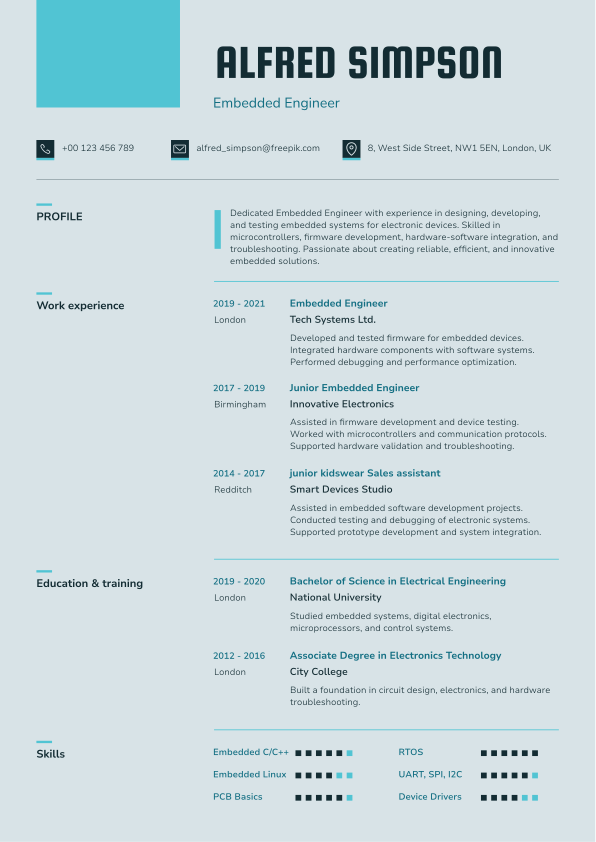
Summary Example
Embedded Firmware Engineer with 5 years developing bare-metal and FreeRTOS firmware on ARM Cortex-M for industrial IoT devices. Shipped firmware across 40K+ deployed units, cut boot time 42% and average current draw 31%, and led board bring-up for 6 custom PCB revisions.
Experience Bullets
Embedded Firmware Engineer | NovaSense Systems | 2022 – Present
- Architected FreeRTOS-based firmware on STM32F4 for a wireless sensor gateway, reducing sensor-to-cloud latency from 180 ms to 110 ms across 12K fielded units
- Rewrote SPI and I2C driver stack with DMA and interrupt coalescing, lowering CPU utilization 26% and extending battery life 19%
- Led board bring-up for 6 PCB revisions, debugging brownout resets with logic analyzers and oscilloscopes, cutting RMA rate 22%
- Shrank firmware image from 612 KB to 498 KB via link-time optimization and dead-code removal, freeing headroom for OTA updates
- Built hardware-in-the-loop regression benches in GitHub Actions, raising test coverage from 45% to 81%
The metrics that matter: interrupt latency (µs), current draw (mA), flash/RAM footprint (KB), boot time, crash/field-failure rate, and release cycle length.
Automotive Embedded Software Engineer Resume
An automotive embedded software engineer resume must show safety-standard fluency — this domain screens on compliance vocabulary as hard as on C skills.
Summary Example
Automotive Embedded Software Engineer with 6 years developing ECU firmware under ISO 26262 (ASIL-B/D). Delivered CAN and LIN communication stacks for 12 vehicle modules in AUTOSAR Classic, cut message latency 28%, and passed two OEM audits with zero critical findings.
Experience Bullets
- Developed AUTOSAR Classic BSW configuration and RTE integration for body control modules across 3 vehicle programs
- Redesigned CAN bus communication firmware in C, cutting message latency 28% across 12 ECU modules
- Enforced MISRA C compliance via Polyspace and PC-lint static analysis, authoring 200+ Unity unit tests for an ASIL-B module with zero critical defects over two release cycles
- Ran HIL testing on dSPACE benches and supported ISO 26262 safety case documentation through OEM audit
- Diagnosed intermittent field faults using CANoe traces, reducing warranty claims 22% and saving $180K annually
Key automotive skills: AUTOSAR (Classic/Adaptive), CAN/CAN-FD/LIN/FlexRay, ISO 26262, MISRA C, UDS diagnostics, CANoe/CANalyzer, dSPACE HIL, Vector tooling.
Embedded Linux Resume: The Higher-Level Track
An embedded linux resume sits between firmware and application development recruiters screen for kernel-space and build-system depth, not just C:
Summary Example
Embedded Linux Engineer with 5 years building BSPs and kernel drivers for ARM Cortex-A platforms. Maintained Yocto layers for 4 product lines, cut image build time 45% and boot time from 14 s to 6 s, and upstreamed 8 patches to mainline kernel subsystems.
Experience Bullets
- Developed and maintained Yocto BSP layers for i.MX8 and Rockchip platforms across 4 product families
- Wrote character and platform device drivers in kernel space for custom sensor hardware, including device tree bindings
- Reduced boot time from 14 s to 6 s via U-Boot trimming, initramfs optimization, and parallel systemd unit ordering
- Integrated OTA update infrastructure (SWUpdate) with A/B partitioning, achieving zero-bricked-device rollout across 8K units
- Debugged kernel panics and memory leaks using ftrace, perf, and kgdb
Key Linux skills: Yocto/OpenEmbedded, Buildroot, device tree, kernel modules, U-Boot, systemd, cross-compilation toolchains, ftrace/perf, Python scripting.
Senior Embedded Software Engineer Resume
A senior embedded software engineer resume adds architecture ownership, mentorship, and process authority on top of technical depth hands-on bullets alone read as mid-level:
Summary Example
Senior Embedded Software Engineer with 10 years architecting firmware for safety-critical medical and industrial devices. Led platform migration across 3 product lines, established the firmware CI and code-review standards now used by 14 engineers, and reduced field defect escapes 60% over two years.
What Separates Senior Bullets
- Architecture: "Defined the firmware architecture for a 3-product platform, enabling 70% code reuse across variants"
- Standards ownership: "Established MISRA C and static-analysis gating in CI, cutting review cycles 40%"
- Mentorship: "Mentored 5 engineers, 2 promoted to senior; authored the team's board bring-up playbook"
- Cross-functional authority: "Ran silicon vendor evaluations and led BOM-cost-vs-performance trade-off decisions with hardware and product"
- Business impact: "Cut warranty costs $180K annually through root-cause analysis of field returns"
Embedded Systems Intern Resume (and Entry-Level)
An embedded systems intern resume and any entry-level embedded systems resume wins on demonstrable hardware work, not coursework lists. Use hybrid format: skills → projects → education → experience.
What Actually Counts
- Real hardware projects — STM32/Arduino/Raspberry Pi builds with measurable outcomes, not tutorials followed
- Board bring-up or PCB work — even a student PCB you populated and debugged
- Open-source contributions — a driver patch, a Zephyr/FreeRTOS fix, a library
- Test evidence — "72-hour stress test, zero deadline misses" beats any claim of familiarity
- Robotics club, capstone, senior design — legitimate experience; list it as experience, not education
Intern-Level Summary
Computer Engineering student with hands-on bare-metal C experience on STM32 and ESP32. Built a multi-sensor data logger with FreeRTOS priority scheduling achieving deterministic 10 ms sampling with zero deadline misses over 72-hour stress tests. Comfortable with SPI, I2C, UART, J-Link debugging, and logic analyzers.
Project Bullet Example
- Built bare-metal C firmware on STM32F103 with custom SPI and UART drivers, debugged with J-Link and logic analyzer, reducing sensor read latency 35% versus HAL-based implementation
Applying to Big Tech: The Google Embedded Engineer Resume Angle
Searching for how to write a google embedded engineer resume or one for Apple, Tesla, Qualcomm, or Blue Origin the differences are real but narrower than people assume:
- Algorithms still matter — big-tech embedded loops include DS&A screens; a competitive programming or algorithms signal helps here more than at hardware-first companies
- Scale language — frame work in deployed-unit counts, not project counts: "firmware running on 2M+ shipped devices"
- Systems breadth — Linux, Python tooling, and CI fluency are expected alongside bare-metal skill
- Referrals move more than resumes — the resume gets you parsed; a referral gets you read
- One page, no exceptions at these companies, even for senior candidates
What doesn't change: quantified bullets, exact keyword mirroring, and platform specificity. A "Google resume" is just a very tight version of a good embedded resume.
What Reddit Says About Embedded Resumes
Browse any embedded software engineer resume reddit thread (r/embedded, r/ECE) and the recurring consensus is consistent with what hiring managers say:
- Projects with photos and scope beat GPA — the most upvoted advice for juniors is "build something and document it"
- Name your parts — "STM32F407, FreeRTOS 10.4, J-Link" reads as real; "microcontrollers, RTOS, debuggers" reads as a syllabus
- Bare-metal cred matters — Arduino-only projects get flagged; register-level work signals depth
- One page, always — r/embedded is unanimous on this
What to ignore from those threads: the pessimism about breaking in without a hardware degree (CS grads with real projects do get hired), and title snobbery about "firmware vs embedded software" apply to both.
Skills Section by Domain
Mirror the posting; prove your top three in bullets.
- Languages: C, C++, Python (tooling/test), assembly basics, Rust (growing in postings)
- RTOS/OS: FreeRTOS, Zephyr, VxWorks, ThreadX, embedded Linux
- Hardware: ARM Cortex-M/-A, STM32, NXP, TI, ESP32, PIC
- Protocols: I2C, SPI, UART, CAN/CAN-FD, LIN, USB, BLE, MQTT, TCP/IP
- Debug/test: JTAG/SWD, GDB, oscilloscopes, logic analyzers, HIL benches, Unity/CppUTest
- Practices: MISRA C, static analysis, secure boot, OTA updates, Git, CI/CD, code review
Certifications worth listing: ARM Accredited Engineer, Yocto Project training, ISTQB (for test-heavy roles), functional safety (ISO 26262) certification, security certifications for connected devices.
Common Embedded Resume Mistakes
- Generic platform language — "worked with microcontrollers" instead of naming the family, RTOS, and toolchain
- No hardware-specific metrics — embedded has the best numbers in software (µs, mA, KB); omitting them wastes your strongest advantage
- Domain-blind resumes — an automotive posting and a Linux BSP posting share almost no keywords
- Task-log bullets — "responsible for firmware development" versus "cut boot time 42% across 40K units"
- Hiding projects — for juniors, projects ARE the experience section; burying them below education is a self-inflicted wound
Frequently Asked Questions
Q1. What should an embedded engineer put on a resume?
Named platforms (MCU family, RTOS, toolchain), protocols, and debug tools each attached to a quantified outcome like latency, power draw, memory footprint, or field-failure rate. Plus projects with links for junior candidates.
Q2. How do I write an embedded resume with no professional experience?
Hybrid format: skills and hardware projects above education. Document real builds with parts named, test evidence, and measurable results. Capstone, robotics club, and open-source contributions all count as experience.
Q3. Is a firmware engineer the same as an embedded software engineer?
The titles overlap heavily — firmware usually implies bare-metal and closer-to-silicon work, embedded software can extend to Linux and application layers. Apply to both, and mirror whichever title the posting uses.
Q4. How long should a senior embedded resume be?
Two pages maximum, and one page is better for big-tech applications. Compress roles older than 10 years into single lines and lead with architecture and platform scope.
Q5. Do embedded roles care about GitHub?
Yes, especially for juniors — but the bar is different from web development. Documented hardware projects with schematics, photos, and test results carry more weight than repo count.
Final Words
An embedded engineer's resume should behave like the firmware they write: deterministic (every claim verifiable), resource-efficient (one page, no filler), and validated (numbers where others have adjectives).
Pick your domain automotive, firmware, Linux, or IoT name every platform and part explicitly, and attach a microsecond, milliamp, or kilobyte to every bullet you can. Then tailor per posting, export the PDF, and ship it.
Your resume runs on a 7-second interrupt. Make sure it returns something useful before the timer expires.