
Entry-Level Financial Analyst Resume: Ultimate Guide, 500+ Line Examples, Formats & 100+ Keyword Templates
An Entry-Level Financial Analyst resume must demonstrate strong financial modeling foundation, quantitative data analysis, corporate budgeting skills, and financial software proficiency: Core Financial Analysis & Modeling (Discounted Cash Flow DCF, 3-statement financial models, variance analysis, net present value NPV, internal rate of return IRR, EBITDA tracking, budget forecasting), Data Analytics & Software Tools (Advanced Excel INDEX/MATCH/XLOOKUP, Pivot Tables, Financial Modeling, Power BI, Tableau, SQL, Python, Bloomberg Terminal, FactSet, SAP, Oracle Financials), Corporate Finance & Investment Operations (Capital budgeting, revenue forecasting, financial ratio analysis, cost-benefit modeling, variance reporting, variance variance analysis, SEC filing analysis 10-K/10-Q), and Financial Credentials (BS in Finance / Accounting / Economics, CFA Level 1 candidate, FMVA - Financial Modeling & Valuation Analyst certification). Finance Directors, Senior Financial Analysts, and Corporate Controllers evaluate an Entry-Level Financial Analyst CV for Excel modeling speed, quantitative precision, financial statement understanding, and internship achievements.
Whether you are writing a Junior Financial Analyst resume, a Corporate Finance Rotational Program CV, a Financial Planning & Analysis (FP&A) Assistant application, a Finance Graduate CV, or an Investment Analyst Intern resume, your document requires high ATS keyword density, advanced Excel modeling credentials, and quantified financial metrics.
This ultimate master guide details the complete Entry-Level Financial Analyst resume framework: ATS formatting standards, key quantitative finance skills matrix featuring 100+ keywords, 4 professional summary examples, 25+ copy-ready metric bullet points, cover letter template, interview prep, salary benchmarks, and 5 detailed FAQs with search keywords.
Corporate Finance, Investment Banking & Financial Analyst Outlook
Financial analysis skills are indispensable across Fortune 500 corporations, investment firms, commercial banks, and technology startups seeking data-driven financial decision making.
To secure top Entry-Level Financial Analyst positions ($65,000 to $85,000 base salary) or Finance Leadership Development Program (FLDP) slots ($90,000+), your resume must showcase advanced Excel modeling, financial ratio analysis, and quantified internship performance.
What Does an Entry-Level Financial Analyst Do? Core Responsibilities
An Entry-Level Financial Analyst analyzes financial data, prepares budget reports, builds 3-statement modeling spreadsheets, and supports senior executives with corporate decision-making. Primary duties include:
- Building and maintaining 3-statement financial models (Income Statement, Balance Sheet, Cash Flow) in Microsoft Excel.
- Performing monthly and quarterly budget variance analysis, identifying revenue and expense discrepancies across business units.
- Extracting financial datasets from ERP systems (SAP, Oracle) and querying database reports using SQL or Power BI.
- Calculating financial valuation metrics including NPV, IRR, WACC, P/E ratios, and EBITDA margins for proposed capital investments.
- Preparing executive financial slide decks and dashboard reports for Senior FP&A Managers and CFO meetings.
- Assisting with annual budgeting cycles, quarterly forecasting, and operational expenditure tracking across departments.
- Analyzing SEC Form 10-K and 10-Q filings for competitor benchmarking and industry equity research.
- Auditing financial records to ensure compliance with GAAP accounting principles and internal financial controls.
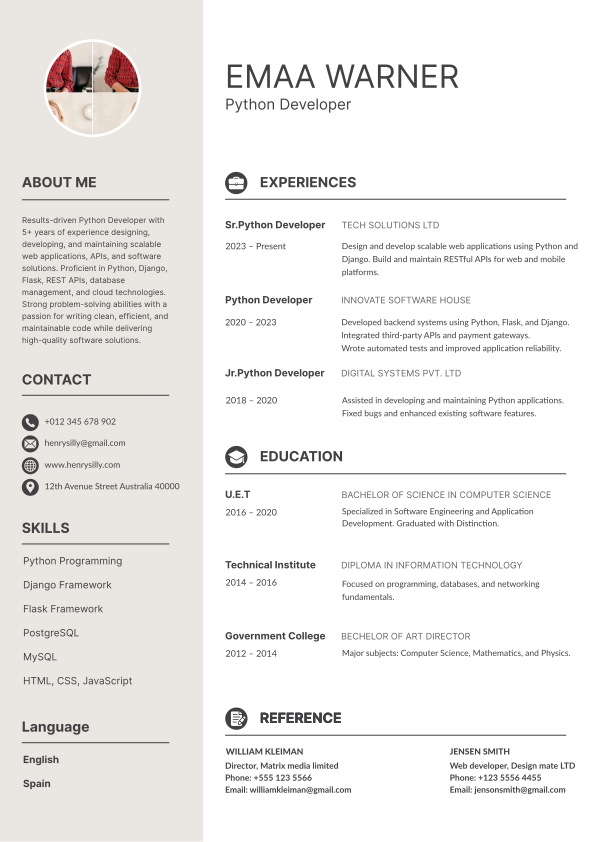
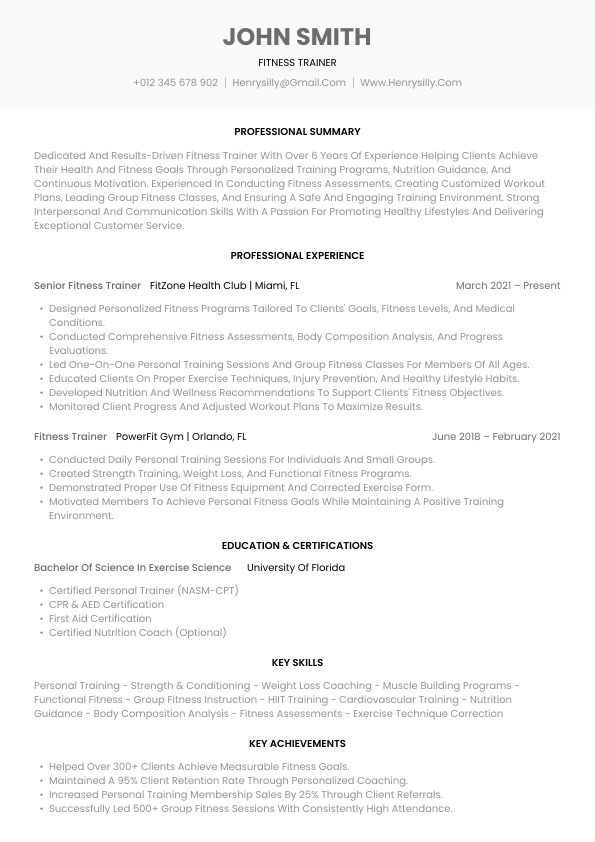
ATS-Optimized Entry-Level Financial Analyst Resume Template

How to Format an Entry-Level Financial Analyst Resume
Finance Recruiters evaluate Analyst CVs for financial modeling proficiency, Excel mastery (XLOOKUP, Index/Match), GPA/academic honors, and data visualization tools:
- Header Credentials: Display full name, target title (e.g. Entry-Level Financial Analyst | B.S. Finance | Advanced Excel & Financial Modeling | CFA Level 1 Candidate), phone, email, and LinkedIn.
- Reverse-Chronological Layout: Highlight finance internships, financial modeling projects, corporate budgeting support, and technical tools (Power BI, SQL, Excel) first.
- Typography & Hierarchy: Use sharp, professional fonts such as Inter, Calibri, or Arial (10–11.5pt body text, 14–16pt section headers).
- Quantified Financial Metrics: Always quantify outcomes (e.g. "Built 3-statement DCF valuation models for 12 corporate projects valued up to $15M, reducing budget variance analysis turnaround time by 30%").
Key Entry-Level Financial Analyst Skills Matrix (100+ Core Keywords)
Financial Modeling & Analysis
- 3-Statement Financial Modeling
- Discounted Cash Flow (DCF) Valuation
- Budget Variance Analysis & Forecasting
- Net Present Value (NPV) & IRR Calculations
- Weighted Average Cost of Capital (WACC)
- EBITDA & Profit Margin Tracking
- Financial Ratio Analysis (Liquidity/Leverage)
- Capital Expenditure (CapEx) Planning
Data Analytics & Software
- Advanced Excel (XLOOKUP, INDEX/MATCH, Pivot Tables)
- Power BI & Tableau Data Visualization
- SQL Database Querying & Reporting
- Python for Financial Data Analysis
- SAP Financials & Oracle ERP Software
- Bloomberg Terminal & FactSet Research
- Financial Modeling & Valuation Analyst (FMVA)
- GAAP & SEC 10-K / 10-Q Filing Analysis
Corporate Finance & FP&A
- Corporate Budget Preparation Support
- Revenue & Expense Forecasting
- Cash Flow Management & Analysis
- Cost-Benefit Financial Analysis
- Competitor Benchmarking & Equity Research
- Monthly Financial Handoff Reporting
- Audit Support & Internal Financial Controls
- Working Capital Management
Certifications & Soft Skills
- B.S. in Finance / Accounting / Economics
- CFA Level 1 Passed / Candidate
- FMVA Certification (CFI)
- High Quantitative Precision & Attention to Detail
- Executive Slide Deck Preparation
- Analytical Thinking & Logical Reasoning
- Cross-Departmental Collaboration
- Deadline-Driven Work Ethic
Entry-Level Financial Analyst Resume Summary Examples
Example 1: Finance Graduate (CFA Level 1 Candidate)
Analytical Finance graduate (3.8 GPA) and CFA Level 1 candidate with financial internship experience in corporate FP&A. Advanced skills in Excel 3-statement modeling, DCF valuation, and Power BI dashboards, having analyzed $20M+ capital budget proposals with zero reporting errors.
Example 2: FP&A Analyst Intern upgrading to Full-Time
Results-oriented FP&A Analyst Intern with hands-on experience conducting monthly budget variance analysis and SAP financial reporting. Streamlined quarterly revenue forecasting models in Excel, saving 8 hours of manual data entry per sprint.
Example 3: Economics Major with Data Science & SQL Skills
Quantitative Economics graduate certified in FMVA and proficient in SQL, Python, and Tableau. Experienced in querying financial datasets, evaluating NPV/IRR metrics, and preparing executive board slide decks.
Example 4: Accounting to Financial Analyst Career Transition
Detail-driven Accounting graduate with experience in ledger reconciliation and GAAP reporting seeking an Entry-Level Financial Analyst role. Advanced user of financial modeling tools and variance reporting.
25+ Copy-Ready Entry-Level Financial Analyst Bullets with Metrics
- Built 3-statement financial models (Income Statement, Balance Sheet, Cash Flow) in Excel to evaluate 15 proposed capital investment projects valued up to $10M.
- Conducted monthly budget variance analysis across 8 corporate departments, identifying $250K in annual operational cost-saving opportunities.
- Automated weekly financial reporting dashboards using Power BI and SQL, reducing report generation time by 35%.
- Analyzed SEC 10-K and 10-Q filings for 20+ competitor companies, authoring equity research summaries for executive management.
- Calculated NPV, IRR, and WACC financial metrics for new product launch proposals, presenting financial feasibility slide decks to FP&A Directors.
- Extracted and reconciled monthly transaction datasets from SAP ERP, maintaining 100% data integrity for audit compliance.
Financial Analyst Credentials & Education
FINANCIAL CERTIFICATIONS
CFA Program Candidate (Level 1 Passed / Scheduled)
CFA Institute
Financial Modeling & Valuation Analyst (FMVA)
Corporate Finance Institute (CFI)
EDUCATION
Bachelor of Science (B.S.) in Finance / Magna Cum Laude (3.8 GPA)
University of Pennsylvania (Wharton School)
Entry-Level Financial Analyst Cover Letter Template
Dear Hiring Manager / Finance Recruiter,
I am writing to express my enthusiastic interest in the Entry-Level Financial Analyst position at [Company Name]. As a B.S. Finance graduate (3.8 GPA), CFA Level 1 candidate, and FMVA certified analyst with hands-on experience building 3-statement Excel models and Power BI dashboards, I am eager to contribute to your finance team.
During my FP&A internship, I conducted monthly variance analysis across 8 departments and automated weekly reporting in Power BI, saving 8 hours of manual data entry per week.
I look forward to discussing how my quantitative modeling and financial acumen will support financial decision-making at [Company Name].
Entry-Level Financial Analyst Salary Benchmarks
- Entry-Level Corporate Financial Analyst: $65,000 – $78,000 base salary
- Junior FP&A Analyst (Mid-Market): $72,000 – $85,000 base salary
- Finance Leadership Development Program (FLDP): $85,000 – $95,000+ base salary + bonus
Frequently Asked Questions (FAQs)
Q1. What are the top keywords for an Entry-Level Financial Analyst resume?
Top keywords include: DCF Modeling, 3-Statement Model, Variance Analysis, Advanced Excel, Power BI, SQL, SAP, NPV/IRR, CFA, and FMVA.
Q2. What Excel functions should be listed on a Finance CV?
XLOOKUP, INDEX/MATCH, Pivot Tables, SUMIFS, IRR/NPV functions, Data Tables, and Financial Modeling Shortcuts.
Q3. Is CFA required for entry-level financial analyst roles?
No, but passing CFA Level 1 or holding an FMVA certificate gives a major advantage for corporate finance and asset management roles.
Q4. Should GPA be listed on an entry-level financial analyst resume?
Yes, list GPA if it is 3.5 or higher, along with academic honors (Cum Laude, Dean's List).
Q5. What is the difference between Corporate Finance and Investment Banking?
Corporate Finance focuses on internal company budgeting, capital allocation, and FP&A forecasting, while Investment Banking focuses on external M&A advisory, underwriting capital raises, and deal execution.