
How to list education on a resume: put your highest or most recent qualification first in reverse-chronological order, and include your degree and major, the school name and location, and your graduation date. Add optional details GPA (if 3.0+), honors, or relevant coursework only when they strengthen your case. Place the section near the top if you're a student, and after work experience if you're experienced. Here's the full formula, with examples for every situation.
Key Takeaways
- List degree + major, school + location, and graduation date — in reverse-chronological order.
- Placement depends on experience: top for students, bottom for seasoned professionals.
- Include GPA only if it's 3.0+ and honors/coursework only when relevant.
- Keep it clean, consistent, tailored, and 100% honest employers can verify it.
What to Include in the Education Section
Every resume should have an education section, even a brief one. As a rule, include:
Degree and major (and minor, if relevant)School name
City and state of the institution
Graduation date (month and year, or expected date)
GPA — only if it's 3.0 or higher and relevant
Optional extras — honors, awards, scholarships, or job-relevant coursework/projects
Match these to the job. For a tech role, highlight relevant programming coursework or projects; for healthcare, clinical or lab work; for finance, financial-modeling classes. Pull keywords from the job description where they fit naturally.
What NOT to Include
Keep the section focused leave out anything that dilutes it:
Irrelevant or outdated education unrelated to your target role.High school once you have a college degree or several years of experience.
Unfinished programs without context — clarify with "Coursework toward [degree]" instead.
A GPA below 3.0 (it's optional — omit it).
Long coursework lists — limit to a few directly relevant classes.
Graduation dates from 15+ years ago if you're concerned about age bias.
Where to Place the Education Section
Placement signals what matters most for your stage:
| Your situation | Where education goes |
|---|---|
| Student / recent graduate | Near the top, above or just under the summary |
| Mid-career professional | After work experience |
| Senior professional | Below skills, near the bottom |
| Career changer | Near skills and certifications, to spotlight relevant training |
The logic: when you have little work history, your education is your strongest proof, so it leads. Once experience carries your candidacy, education moves down. See how to write a resume with no experience for the student version.
How to Format Education on a Resume?
Keep it organized, consistent, and easy to scan:
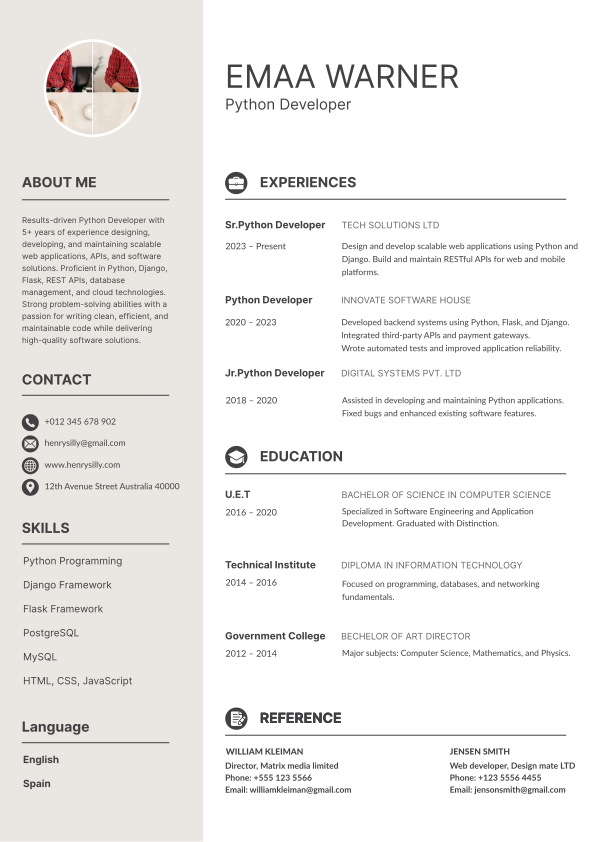
- Reverse-chronological order — highest or most recent degree first.
- Degree and major first, so level and focus are instantly clear.
- School name and location second (e.g., "University of Washington, Seattle, WA").
- Optional details last — graduation date, honors, relevant coursework.
- Consistent formatting — same font, spacing, and bullet style across every entry.
Standard example:
EDUCATION Bachelor of Science in Marketing — University of Central Florida, Orlando, FL May 2025 | cum laude
- Relevant coursework: Digital Marketing, Consumer Behavior, Market Research
Multiple degrees:
Master of Arts in Public Policy — Stanford University, Stanford, CA — June 2022 Bachelor of Arts in Political Science — UC Berkeley, Berkeley, CA — May 2020
How to List Education as a Student
If you're still studying, your education section does more work — so give it more detail and place it near the top.
High school student:
EDUCATION Valley High School, Boise, ID — Expected Diploma: 2027
- Member, National Honor Society
- Chess Club Secretary, 2024–Present
College student (in progress):
EDUCATION Bachelor of Science in Civil Engineering — Temple University, Philadelphia, PA Expected Graduation: May 2027
- Current GPA: 3.8 | Dean's List, all semesters
- Relevant coursework: Statics, Fluid Mechanics, Geotechnical Engineering
- President, ASCE student chapter
Show your expected graduation date — it signals confidence you'll finish, and helps employers plan.
Special Circumstances
Unfinished / incomplete degree — list the program, school, and credits completed, then pivot to relevant coursework or projects. Don't explain why you didn't finish on the resume; save that for the interview.
University of Hawaii, Honolulu, HI — 2023–2024
- Completed 40 credits toward a BA in Graphic Design
- Coursework: Digital Imaging, Branding & Visual Identity
In-progress degree — state the program, school, and expected graduation date, and add a few relevant courses.
Transfer schools — list both institutions with their dates; the degree-granting (or most recent) school comes first.
GED — a fully recognized qualification; list it plainly. It's no less valid than a traditional diploma.
Older professionals — you can list the degree and school but drop graduation dates if they were 15–20+ years ago, the same way you'd trim very early roles.
How to List Continuing Education and Certifications
Ongoing learning shows initiative — and in many fields, certifications are make-or-break. Put them in a dedicated "Certifications" or "Professional Development" section near your education.
CERTIFICATIONS Certified Scrum Master (CSM) — Scrum Alliance — August 2024 Project Management Professional (PMP) — PMI — July 2023 Google Analytics Certification — Google — April 2023
Use full names (not just acronyms), list only role-relevant credentials, and note "in progress" with an expected date where applicable. These pair well with a strong skills section and reinforce what makes a resume stand out.
Tips for a Strong Education Section
- Be 100% honest — education is easy to verify, and lying is a fireable offense.
- Lead with your most relevant qualification, even if it isn't the most recent (a current industry certification can outweigh an old degree).
- Quantify achievements where you can ("Dean's List, 3 consecutive semesters," "top 5% of class").
- Keep it ATS-friendly — standard heading, clean bullets, keywords from the posting. Confirm with the ATS Resume Checker.
- Tailor every time — cut education that isn't relevant so every line earns its place.
Frequently Asked Questions
Q1. How should you list education on a resume?
In reverse-chronological order, starting with your highest or most recent degree. Include degree and major, school name and location, and graduation date, plus optional honors or coursework kept clean and consistent.
Q2. Is it okay to leave education off a resume?
It's fine to de-emphasize it if your experience, skills, or certifications are more relevant but include at least the basics. Add it fully whenever the employer requires a specific degree or certification.
Q3. Should you include your GPA?
Only if it's 3.0 or higher and you're a recent graduate, or the employer requests it. Otherwise, leave it off and let stronger qualifications lead.
Q4. Where should the education section go?
Near the top for students and recent graduates; after work experience for mid-to-senior professionals; near skills for career changers.
Q5. How do you list an unfinished degree?
List the program, school, and credits completed, then highlight relevant coursework or projects. Don't explain why it's incomplete on the resume address that in the interview if asked.
Q6. When should you remove education dates?
Consider dropping graduation dates for degrees earned 15+ years ago to avoid age bias, and drop high school once you have a college degree or solid work experience.
The Bottom Line
Listing education well is about relevance and clarity, not length. Lead with your strongest qualification, format it consistently, place it where it best supports your candidacy, and tailor it to each role. Say just enough to signal the credential and save the deeper story for the interview.
Ready to build it? Create your resume with AI and AI Resume Lab will format your education section correctly for your experience level and industry.